Building Nuclear on the Right Foundations
Strong Pillars, Fewer Surprises.
As U.S. energy demand accelerates — especially from data centers — and reliability returns to the center of national strategy, nuclear power is moving from “future option” to “current necessity.” Over the last five years, momentum has surged around established reactor designs (e.g. AP1000) and advanced reactor designs, with projects now shifting from concept slides to concrete, steel, and field execution.
But new technology alone does not deliver new outcomes. If owners want predictable cost, schedule, and performance, they should expect reactor design suppliers to build on disciplined foundations: strong front-end definition, rigorous design control during execution, and clear governance from concept through startup. In nuclear, success is rarely a breakthrough moment. It's the cumulative result of getting the fundamentals right, early, and continuously.
Strong in Flight: Foundations for Predictable Nuclear Delivery
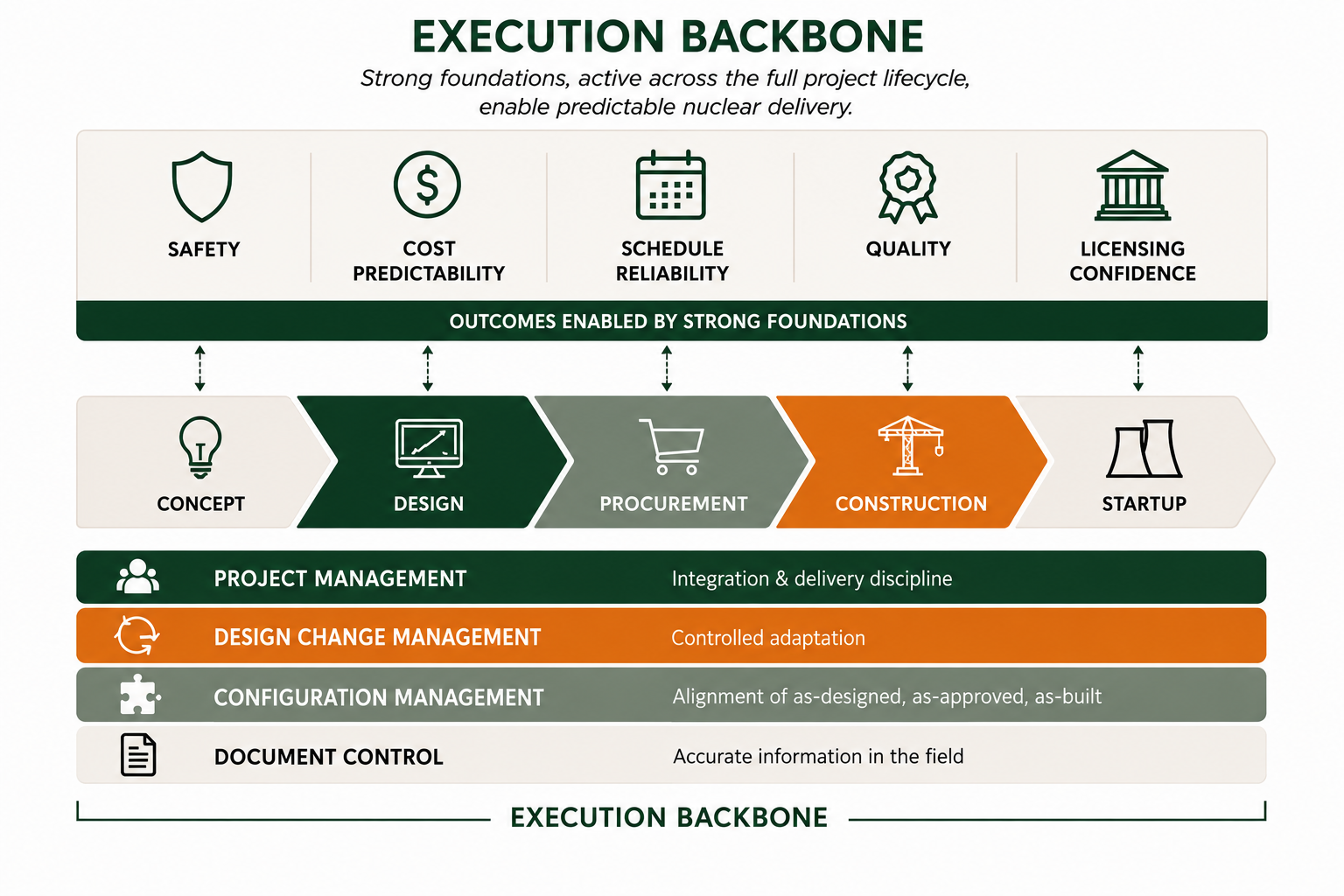
Nuclear project foundations cannot be treated as a one-time startup task. They must be established before construction and remain active through execution, keeping safety, cost, schedule, and technical integrity aligned as complexity and change accelerate. There are four connected pillars that original equipment manufacturers (OEMs) must be prepared to address: project management (integration and delivery discipline), design change management (controlled adaptation), configuration management (alignment of as-designed, as-approved, and as-built states), and document control (accurate information in the field). Together, these pillars form the execution backbone that reduces rework, prevents delays, and enables predictable outcomes from concept through startup.
Risk, Cost, and Schedule Exposure When Foundations Are Weak
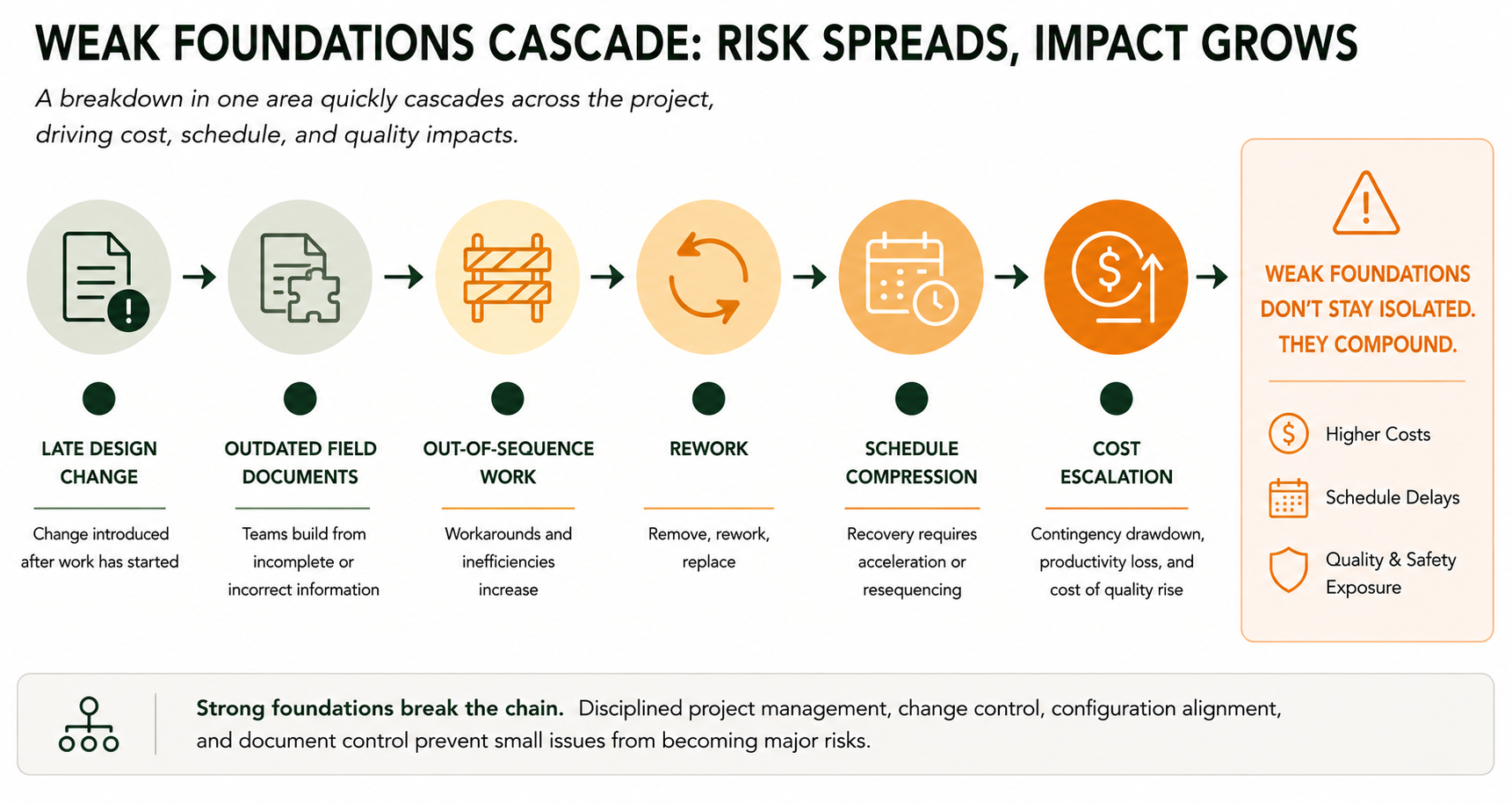
When project foundations are weak, risk does not stay isolated. It spreads quickly across engineering, procurement, construction, and startup. Gaps in project management, design change control, configuration alignment, and document control lead to out-of-sequence work, rework, delayed decisions, and field execution against incomplete or outdated information. The result is predictable: rising contingency drawdown, productivity losses, schedule compression, and increased cost of quality. In nuclear delivery, weak foundations are not just an efficiency problem but a direct threat to cost certainty, schedule reliability, and overall confidence in new nuclear builds.
What Good Looks Like in Practice
High-performing nuclear organizations know a hard truth: you can't “hero your way” through a mega-project with spreadsheets, hallway decisions, and crossed fingers. Project management, configuration control, document control, and change management are treated as production infrastructure — the steel frame of the project rather than office admin. They are activated early and kept running through design, procurement, construction, turnover, and startup. The result? Engineering, licensing, quality, project controls, procurement, and construction all work from the same playbook, with clear authority and clean handoffs, so decisions account for safety, regulatory obligations, constructability, schedule, and cost at the same time — not one painful surprise at a time.
They also make change control practical, not performative: releases move only when maturity gates are met, and changes are screened against technical, licensing, and execution risk before they hit the field. Backing that up with a living digital thread — from requirements through turnover — helps teams find the truth quickly, resolve issues faster, and avoid costly rework.
Upcoming Series: Lessons from the Field for Predictable Nuclear Delivery
Solestiss engineering and project management leaders have been at the forefront of multiple first-of-a-kind nuclear new build projects in the U.S. and beyond, and have learned firsthand what constitutes good field readiness and the implications of falling short. This summary is the first in a five-part series in which Solestiss will share phase-based recommendations drawn from our collective, firsthand experience across nuclear projects — what consistently worked, what created avoidable friction, and what most improved delivery outcomes. Our objective is practical: to underscore the importance of not short-changing resource commitment and time allowance for these activities. Teams that apply proven controls early, sustain them through execution, and avoid repeating known failure patterns related to these foundational pillars are not guaranteed success, but they will dramatically reduce risk throughout the project lifecycle.
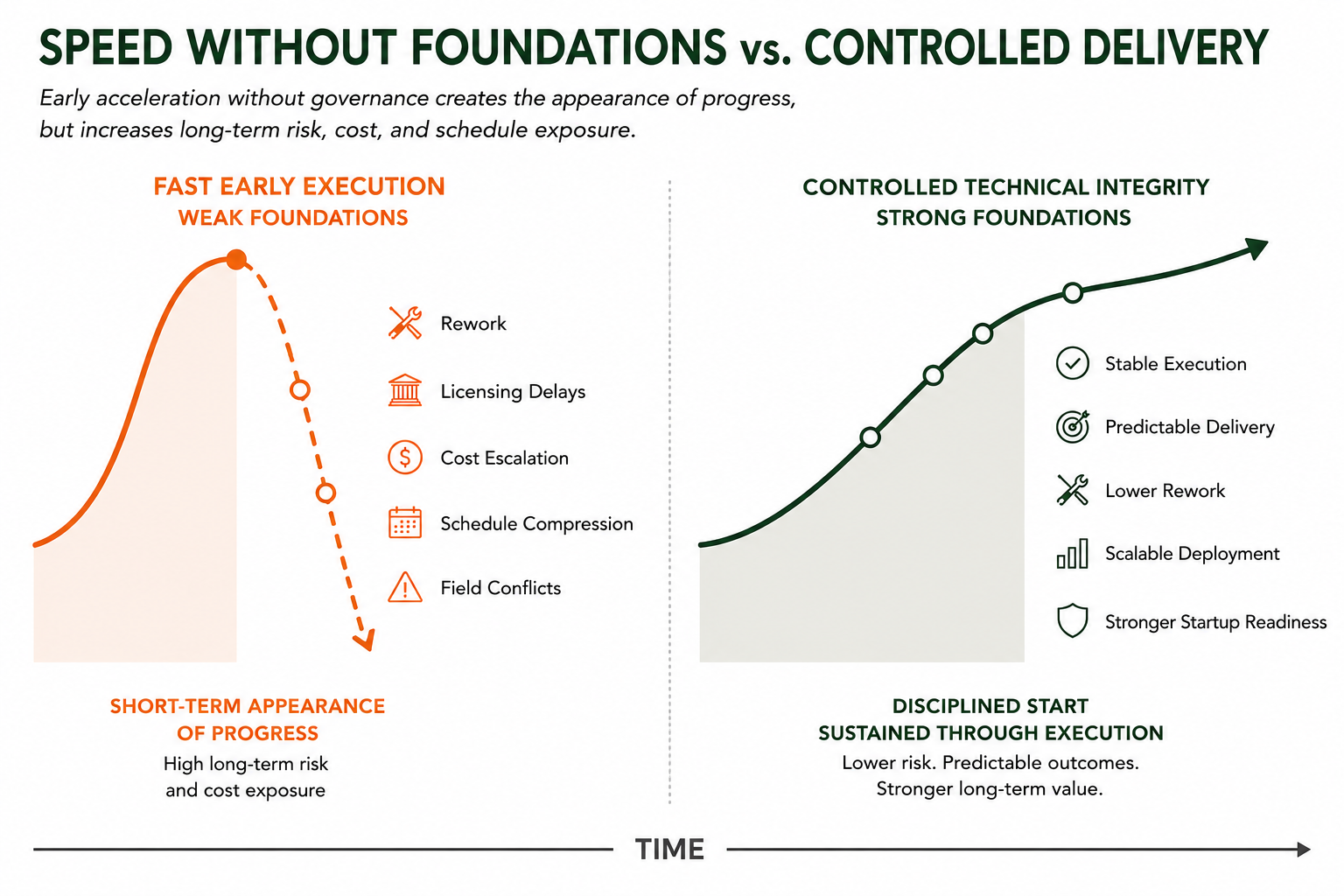
Strong nuclear outcomes are achieved by moving with controlled technical integrity, not by moving fastest at the start. Accelerating field execution without governance maturity can create the short-term appearance of progress while increasing long-term cost, schedule, and licensing exposure. Establishing and sustaining design foundations from day one is one of the highest-leverage actions leadership can take to improve safety, execution predictability, and program scalability.
Nuclear projects are often described as engineering megaprojects. In practice, they are configuration-intensive, evidence-driven delivery systems where disciplined design governance determines outcomes. A strong foundation in configuration management, document control, change management, and regulatory code incorporation protects safety, enables predictable execution, and supports commercial viability.
Kim Smiley is an Executive Consultant at Solestiss advising clients on advanced nuclear strategy, market positioning, and execution planning for complex energy initiatives. She began her career as an engineer in the U.S. Naval Nuclear Propulsion Program and brings a practical, systems-oriented perspective to helping organizations navigate first-of-a-kind projects and turn strategy into executable plans.